|   | Shou el akhbar. An Iranian ballistic missile exploded over Keserwan on Tuesday—and Lebanon's army just confirmed exactly what it was, where it came from, and why the official story some outlets ran was wrong. Also today: a historian who shaped how the world understands Palestinians is gone at 100, and a sharp analysis asks whether Lebanon's Shia community is heading toward the same decade-long political isolation that Christians lived through after Taif. |
|
| | The Missile Over Keserwan: Iran's Qadr-110 ConfirmedThe backstory: Since late 2024, Israeli strikes have concentrated on south Lebanon and Beirut's southern suburbs. Keserwan—a predominantly Christian district north of Beirut—had been largely spared. Tuesday's explosion over the area sent shockwaves well beyond the physical blast radius.
- The Lebanese Army confirmed Wednesday that the projectile was a Qadr-110 Iranian-made guided ballistic missile, approximately 16 meters long with a range of roughly 2,000 kilometers, containing several smaller submunitions.
- The army stated the missile exploded at high altitude, indicating its intended target was outside Lebanese territory, and that the cause was either a technical malfunction or an interceptor missile—with no interceptor launchers present on Lebanese soil.
- Earlier reports from MTV and Nida al-Watan had claimed the IRGC fired the missile from the Bekaa Valley toward the US Embassy in Awkar—a version that military analysts and satellite data contradicted, given the missile type's ballistic trajectory and the physics of high-altitude interception.
- The Lebanese army's findings align with Israeli military leaks and open-source military analysts who identified the engine fragments in Kfardebian as consistent with liquid-fueled Iranian ballistic systems, ruling out a short-range domestic launch.
Why it matters: A long-range Iranian ballistic missile exploding over Lebanese civilian airspace—whatever its intended target—signals a dangerous escalation of the regional conflict playing out in Lebanese skies, and exposes how quickly misinformation can inflame sectarian tensions on the ground. Will Lebanon's Shia Community Repeat the Christians' Post-War Mistake?
- A major analytical piece argues that Lebanon's Shia community—roughly 35% of the population—faces a pivotal post-war moment that echoes the disastrous isolation Christian communities experienced after the 1989 Taif Agreement.
- After 1990, wide swaths of Lebanon's Christian community boycotted the 1992 parliamentary elections, viewing the Syrian-dominated state as illegitimate—a decision that weakened their representation for over a decade and deepened a cycle of emigration and political marginalization.
- Today, the parallel pressures on the Shia community include the 2024 war's destruction, declining Iranian funding, damage to Hezbollah's organizational and services infrastructure, and the fall of Assad's Syria—all opening space for internal rethinking.
- The analysis argues the lesson from Christian history is clear: disengagement from state institutions, however emotionally justified, leads to long-term erosion of political weight—and the path forward is painful engagement, not withdrawal.
Zooming out: The question isn't just about Hezbollah's weapons—it's about whether Lebanon's largest communities can resist the pull of sectarian retrenchment and choose state-building over parallel structures, a choice that will define the country's next generation. Walid Khalidi, Palestinian Historian Who Rewrote the Nakba Narrative, Dies at 100
- Walid Khalidi, the Jerusalem-born, Beirut-based scholar who first documented how 750,000 Arab Palestinians fled or were expelled in 1947–1948, died at the age of 100, leaving behind more than 40 books and a transformed understanding of Palestinian history.
- In 1963, Khalidi co-founded the Institute of Palestine Studies in Beirut—still a leading independent research center—and served as its general secretary until 2016.
- His landmark 1978 Foreign Affairs article, "Thinking the Unthinkable," was the first detailed public case for a Palestinian state on Gaza, the West Bank, and East Jerusalem alongside Israel—written with Arafat's private blessing but against fierce internal Palestinian opposition.
The bigger picture: Khalidi's life—spanning Jerusalem, Beirut, Oxford, and Harvard—embodied the Palestinian diaspora's intellectual project: making dispossession legible to a world that preferred the myth of the voluntary departure. |
|
How long is the Lebanon Mountain Trail approximately? Scroll to the bottom for the answer — or play all 10 at sobhiye.news/games/trivia |
| | - Five divisions, one border: Five Israeli army divisions—including the 36th, 91st, 162nd, 210th, and 146th—are now poised for expanded ground operations in south Lebanon, with the 91st and 36th already deployed in what Israel calls a "focused operation."
- Scorched earth, documented: A researcher at Delft University mapped nearly 250 uses of white phosphorus by Israeli forces in south Lebanon between October 2023 and November 2024, with 39% in residential areas and over 2,000 hectares of countryside burned.
- Baalbek counts its dead: Since fighting resumed March 2nd, Lebanon's health ministry says more than 1,000 people have been killed—including at least 120 children—with over 1 million newly displaced and 14% of Lebanese territory under forced evacuation orders.
- Master of many faces: Lebanese Internal Security Forces arrested a serial fraudster who impersonated four different identities—including two plastic surgeons and a customs broker—stealing between $500 and $50,000 per victim across Tyre, Tripoli, and Mount Lebanon, according to an ISF statement.
- MEA's week of chaos: Middle East Airlines cancelled or merged dozens of flights through March 30th—including routes to Dubai, Rome, Athens, Frankfurt, and Abu Dhabi—due to regional airspace closures, while warning passengers that no-show fees now reach $500 for business class.
|
|
| ─ | Parallel Rate | 89,700 LBP | 0.00% | | ─ | Official Rate | 89,500 LBP | 0.00% | | ▼ | Bitcoin | $69,976 | -1.69% |
as of 6:44 AM GMT · Source: Yahoo Finance, CoinGecko |
| | Gaza Toddler Released From Israeli Custody With Apparent Burn Wounds
- Jawad Abu Nassar, aged 21 months, was detained alongside his father Osama in central Gaza on March 19th, near the so-called "Yellow Line" demarcation zone, after his father—suffering severe trauma from losing his home and unborn child—walked toward Israeli positions.
- The ICRC retrieved the toddler approximately 10 hours later at Kissufim Crossing and returned him to his family in central Gaza; medical reports reviewed by Middle East Eye confirmed "knee swelling" and "wounds around both knees, mostly due to cigarette marks."
- An Israeli military spokesperson rejected the abuse claims, stating the child "received care and was under the full supervision of an IDF physician" and that the toddler had been brought into a dangerous area "to be used as a human shield."
- Since the ceasefire agreement in October, dozens of Palestinians have been killed, injured, or detained near the Yellow Line, which covers around 60% of Gaza's land area.
What to watch: The ICRC has confirmed it cannot comment on the child's physical or psychological condition due to privacy concerns, meaning independent verification of the injury claims remains pending as international pressure over Gaza detention conditions intensifies. UN Formally Recognizes Slave Trade as 'Gravest Crime Against Humanity,' Calls for Reparations
- The UN General Assembly passed a resolution Wednesday formally recognizing the trafficking of enslaved Africans as "the most inhumane and enduring injustice against humanity," with 123 votes in favor, 3 against, and 52 abstentions within the 193-member body.
- Argentina, Israel, and the United States voted against the resolution, while the United Kingdom and several EU member states abstained; the UK's acting UN Ambassador acknowledged slavery's "devastating consequences and long-lasting impacts" while pointing to modern slavery as the priority concern.
- The resolution calls on UN member states to engage in talks on "reparatory justice," including formal apologies, restitution, compensation, and the prompt return of cultural artefacts—including artworks, monuments, and national archives—to their countries of origin without charge.
Zooming out: Unlike Security Council resolutions, General Assembly resolutions are not legally binding, but the lopsided vote—with most of the Global South in favor—reflects a deepening divide between former colonial powers and the nations that bore the cost of the slave trade. 'Miracle' HIV Drug Lenacapavir Begins Rollout in Nine High-Risk Countries
- Lenacapavir, a twice-yearly injection described by the head of UNAIDS as "the closest thing we have to a vaccine" against HIV, has begun its first-ever rollout in nine of the most at-risk countries, starting with Eswatini in southern Africa, where roughly a quarter of adults aged 15–49 live with HIV.
- The current plan, funded by the Global Fund to Fight AIDS, TB and Malaria, aims to deliver the drug to 2 million people by 2028—less than 10% of the 20 million people UNAIDS says need PrEP in the coming years to end the epidemic.
- The rollout comes after devastating US foreign aid cuts upended progress toward ending the AIDS pandemic by 2030; in wealthy countries, lenacapavir costs up to $24,000 per year, though it is being delivered to the poorest nations at significantly reduced cost.
The bigger picture: MSF's country lead in Eswatini warns that reaching only 2 million people while cutting global aid infrastructure is "a piecemeal solution"—and history shows that piecemeal solutions for infectious diseases, as seen during COVID-19, ultimately fail everyone. |
|
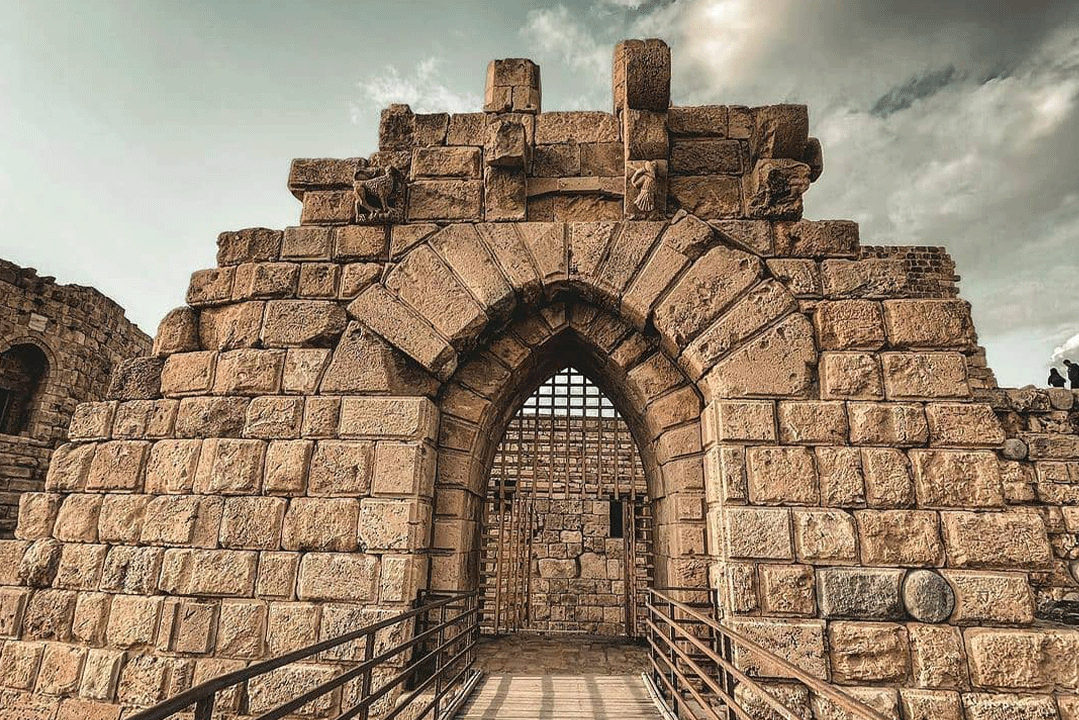
| | - Byblos lands in Paris: French President Macron opened the "Byblos, an Ancient City" exhibition at the Arab World Institute in Paris, calling Lebanon "a country that blends civilizations and presents an alternative face to violence—a face of civilization and intellect." Lebanon's 7,000-year-old port city is having a moment in the City of Light.
- Knefeh purists, rejoice: Lebanese-born chef Jad Youssef has released his debut cookbook Lebnani, a love letter to authentic Lebanese cuisine—over 200 mezze dishes, zero sweet potato falafel, and absolutely no corn flake knefeh. His Surrey restaurant is proof the diaspora is holding the line on tradition.
- Tour Lebanon from your couch: A UNESCO Beirut and Ministry of Culture collaboration has made 8 of Lebanon's most iconic archaeological sites—including Baalbek, Byblos, and the National Museum of Beirut—accessible via free virtual tours, so your jiddo in the diaspora can finally walk through Tyre without leaving his armchair.
- Haaland buys a Viking book: Manchester City striker Erling Haaland donated a rare 1594 edition of Viking sagas—purchased for £100,000, a Norwegian record—to his hometown library in Bryne, saying "books give so many more people the chance to dream big." The Premier League's top scorer with 22 goals this season is also, apparently, a patron of the arts.
|
|
Thanks for reading—see you tomorrow. |
The LMT is approximately 470 km long. |
Lebanon news for the diaspora — delivered every weekday morning. Free, sharp, ~5 minutes. |
|
|
|
|