|   | Sabah el kheir. While the family WhatsApp group debates whether to forward the latest ceasefire rumor or wait for confirmation, we did the reading for you. Today: the civil war question everyone's asking but nobody wants to answer, a 21-year-old from Nabatieh who built something remarkable from his displacement, and what Israeli border settlers actually want for southern Lebanon. |
|
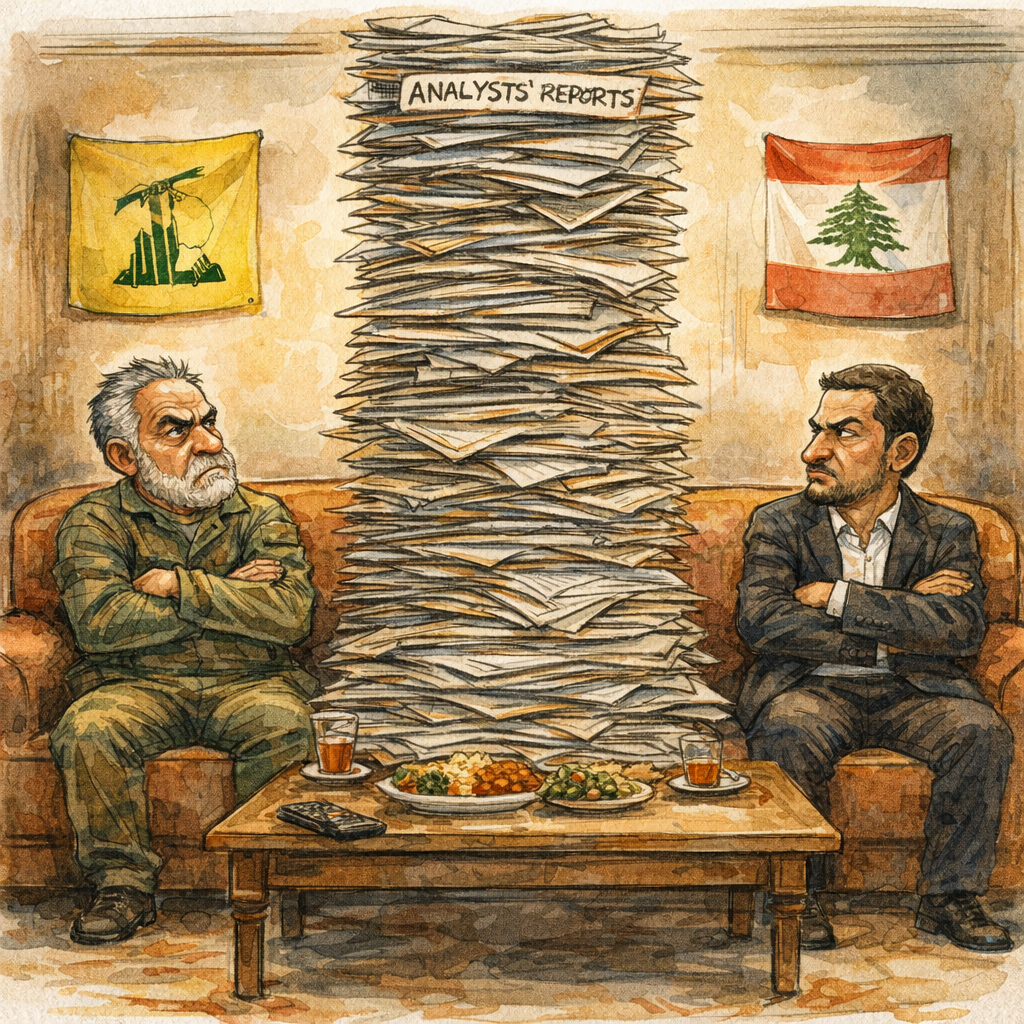
| The Civil War Question: Analysts Say It's Unlikely—Here's Why
- A new analysis in The National, translated by Lebanon24, argues that a new Lebanese civil war is unlikely—despite real sectarian tensions caused by the displacement of more than 1 million Shia residents into non-Shia areas after Israeli evacuation orders.
- The report identifies four structural barriers: no other sect has taken serious steps to arm or mobilize, Iran has no interest in allowing Hezbollah to waste its forces in an internal conflict, Sunnis empowered by Assad's fall present a front Hezbollah can't win against, and Christian communities would likely defend their own enclaves rather than coordinate offensively against anyone.
- Crucially, Hezbollah may actually seek to de-escalate internally—focusing its remaining military capacity on resisting Israeli presence in the south, a position that could find grudging acceptance across Lebanon's fractured political map.
- The report warns, however, that if Hezbollah attempts to reassert dominance over other Lebanese communities, armed resistance becomes almost certain.
The backstory: Lebanon's 1975–1990 civil war killed an estimated 150,000 people and involved at least a dozen armed factions across religious lines. The country has never fully disarmed or reconciled, and Hezbollah has since become the dominant military force—a fact that underpins almost every political tension today.
What to watch: Whether Hezbollah chooses to consolidate internally or redirect toward the Israeli front will be the single most consequential variable in Lebanon's near-term stability. "I Want to Occupy": The Israeli Settler Movement With Eyes on Southern Lebanon
- An investigation by The Intercept reveals that residents of Israeli border communities—evacuated after October 7, 2023—are openly pushing for the permanent depopulation and settlement of southern Lebanon up to the Litani River.
- Eyal Adom, head of security for Moshav Netu'a, told The Intercept: "I want to occupy southern Lebanon. Move all the Arabs from there, up to the Litani River"—a fringe view that the report says has grown significantly more mainstream since October 2023.
- Israel's military is facing a manpower crisis, reportedly short more than 15,000 soldiers, making a sustained ground occupation logistically implausible—but that hasn't stopped the Uri Tzafon ("North Awaken") movement from launching drones into southern Lebanon and breaching the security barrier as settlement demonstrations.
- Israel has logged more than 10,000 ceasefire violations since the November 2024 agreement, and continues to hold five "strategic" hilltops inside Lebanese territory in defiance of ceasefire terms.
Zooming out: The settler movement's explicit ambitions for southern Lebanon—modeled on the Golan Heights annexation—represent a political pressure on the Israeli government that operates independently of any diplomatic track, including the Washington talks. A 21-Year-Old From Nabatieh Built Lebanon's First Strike-Tracking Map
- Ali Sbeiti, a 21-year-old computer science graduate from Nabatieh, built "Red Alert Lebanon"—an interactive map that aggregates strike data from multiple media sources, runs it through AI analysis, and plots Israeli attacks in real time on a single platform.
- Sbeiti began the project during his own displacement from the south, motivated by a simple frustration: tracking strikes required toggling between dozens of sources, none of them Lebanese-made or Lebanese-centered.
- The site reached more than 11,000 users within its first month of launch—with diaspora users identified as among the most active, using it to check strike proximity to their home villages when Arabic place names in news reports mean nothing without a map.
- Most media outlets currently rely on Israeli-produced maps to report on Israeli strikes inside Lebanon—making this the first locally developed tracking initiative of its kind, built on open-source data and AI-assisted pattern analysis.
Why it matters: In a conflict where the information environment is dominated by one side's tools, a Lebanese-built counter-mapping platform—however early-stage—represents a meaningful assertion of narrative ownership over what's happening to Lebanese land. |
|
"Man 7afar fekhan li akhiih, wa2a3 fiyih" implies: | | | Karma through one's own actions |
| |
Scroll to the bottom for the answer — or play all 10 at sobhiye.news/games/trivia |
| - Lebanon negotiates for Lebanon: In a historic shift, Lebanon entered its first-ever direct contact with Israel via U.S.-mediated conference call, with Ambassador Nada Hamadeh Moawad reiterating that a ceasefire must come before any formal talks—and that Iran speaks for nobody but itself at this table.
- "Everything is gone": The Israeli military demolished entire border villages—Taybeh, Naqoura, and Deir Seryan—using controlled explosives, following Defense Minister Katz's explicit order to destroy "all houses" along the border using the same model applied in Rafah. Rights groups say it may constitute a war crime.
- Beirut's lifeline, still open: Lebanon's Public Works Minister confirmed food security stocks are sufficient for three months, while Beirut Port processed roughly 600 transactions in its first three hours of Saturday's exceptional opening—and the airport remains operational despite the escalation.
- Three-quarters of the war hit us: An AFP analysis of ACLED data found that Lebanon and Iran absorbed roughly three-quarters of all strikes during the war—at least 7,700 recorded attacks between February 28 and April 8, with Israel destroying 15 bridges in Lebanon alone.
- Washington's promise to Beirut: Kuwait's Al-Anbaa reported that the U.S. informed Lebanon that Israel will not strike Beirut again, citing American pressure following international outcry—particularly from Arab states, France, and the EU—after "Black Wednesday" killed hundreds of civilians.
|
|
| ─ | Parallel Rate | 89,550 LBP | 0.00% | | ─ | Official Rate | 89,500 LBP | 0.00% | | ▲ | Gold | $4,787.4 | +0.54% | | ▼ | Bitcoin | $71,516 | -1.79% | | ▲ | S&P 500 | 6,816.89 | +0.50% |
as of 5:09 AM GMT · Source: lbprate, BDL, Yahoo Finance, CoinGecko |
| Iran's Wounded Supreme Leader Is Running a War From an Audio Call
- Iran's new Supreme Leader Mojtaba Khamenei, 56, suffered severe facial disfigurement and significant leg injuries in the February 28 airstrike that killed his father, with three sources close to his inner circle telling Reuters he remains mentally sharp but has not appeared publicly since his appointment on March 8.
- Khamenei is participating in meetings via audio conferencing and engaging in decisions on the war and Washington negotiations, though a source familiar with U.S. intelligence told Reuters he is believed to have lost a leg—a claim the CIA declined to confirm.
- Sources say images of the supreme leader could be released within one or two months; in his absence, the Revolutionary Guards have emerged as the dominant voice on strategic wartime decisions, raising questions about the true locus of power in Tehran.
What to watch: Whether Mojtaba Khamenei can consolidate authority the way his father did over decades will shape Iran's negotiating posture, its military strategy, and the durability of any ceasefire agreement with the United States. The Satellite Blackout: US Pressure Cuts Off Journalists and Aid Groups From Middle East Imagery
- California-based Planet Labs, acting on a U.S. government request, has moved from a 14-day delay on Middle East satellite imagery to an indefinite "managed distribution" policy—blocking access to images taken after March 9 across most of the region, including Lebanon, Iraq, Israel, and Gaza, according to BBC Verify.
- Humanitarian organizations including Oxfam told BBC Verify the restrictions directly hamper their ability to plan evacuations, assess infrastructure damage, and coordinate aid delivery in active conflict zones where in-person access is impossible.
- Experts warn the blackout has created a vacuum filled by fake satellite imagery, with one mapping platform tracking "a massive spike" in fabricated images during the conflict, while non-U.S. alternatives like the European Space Agency offer lower resolution that cannot distinguish individual vehicles.
The bigger picture: When commercial satellite providers double as defense contractors, the line between voluntary compliance and government censorship of the visual record of war dissolves—with consequences for accountability that extend well beyond any single conflict. Iran's Lego Propaganda Machine: Hundreds of Millions of Views, One Admitted Government "Customer"
- A BBC investigation into Explosive Media—one of the primary accounts producing viral AI-generated, Lego-style propaganda videos about the war—found that its representative, "Mr. Explosive," admitted for the first time that the Iranian government is a direct "customer," despite the outlet previously claiming total independence.
- The clips, estimated to have been viewed hundreds of millions of times, depict scenes including dying children, downed U.S. aircraft, and Donald Trump falling through Epstein documents—and are regularly amplified by Iranian and Russian state media accounts on X to millions of followers.
- Leading propaganda expert Dr. Emma Briant described the content as "highly sophisticated," noting that AI tools trained on Western data allow authoritarian states to produce "culturally appropriate" content targeting Western audiences more effectively than ever before—a capability that previously eluded them.
Zooming out: State-adjacent AI propaganda that operates faster than fact-checkers, bypasses traditional media, and mimics a globally recognizable aesthetic represents a structural shift in how governments wage information warfare during armed conflict. |
|
| - Holy fire reaches Beirut: The Holy Fire arrived in Beirut from Jerusalem's Church of the Holy Sepulchre on Saturday evening, landing at Rafic Hariri International Airport around 6:30 PM before being transferred to the Presidential Palace and distributed to churches and parishes across Lebanon—a centuries-old tradition that this year carries extra weight.
- $200K and 42,000 plates: The diaspora-backed "Soffra" initiative, launched by Lebanon's ambassador to the UK, delivered roughly 42,000 meals across 19 shelters at just $3 per plate—supporting displaced families while keeping local restaurant workers employed, with a goal of scaling to $1 million per month.
- Beirut on the menu in L.A.: Rose Previte's new Maydan restaurant in West Adams, Los Angeles—rooted in her Lebanese mother's cooking—is wowing critics with its sayyadiah, baharat lamb shoulder, and Lebanese wine list inside a stunning 10,000-square-foot food hall.
- The Gypsy King is back: Tyson Fury defeated Arslanbek Makhmudov by unanimous decision—120-108 on two scorecards—in his boxing comeback at age 37, then immediately called out Anthony Joshua for what promoters are billing as the biggest fight in English boxing history.
|
|
Thanks for reading—see you tomorrow. |
 | | Illustrated by AI |
|
| ✓C. Karma through one's own actions |
Harm rebounds through your own scheme, not fate alone. |
Lebanon news for the diaspora — delivered every weekday morning. Free, sharp, ~5 minutes. |
|
|
|
|


