|   | Sabah el kheir. Lebanon's army is ranked 118th in the world, and there's a US law deliberately keeping it that way—while students across the country hold their breath over what their exams will actually look like this year. Oh, and a southern town called Hula has a history lesson that puts the current war in a whole new light. |
|
| | The Doctrine That Keeps Lebanon's Army Weaker Than Hezbollah
- Israel has conducted over 100 strikes across Lebanon since the conflict reignited, killing 361 people in a single day on April 8—dubbed "Black Wednesday"—in an operation the Israeli military called "Operation Eternal Darkness," per France 24.
- A US policy known as "qualitative military edge" (QME), enshrined in US law in 2008, legally requires Washington to ensure arms sales to Middle Eastern countries don't undermine Israel's military superiority—including caps on aid to Lebanon's armed forces.
- Lebanon's army currently ranks 118th out of 145 countries on the 2026 Global Firepower index, and US envoy Tom Barrack made headlines with a blunt admission: "We don't want to arm them… so they can fight Israel? I don't think so."
- Since Israel's founding, the US has provided over $300 billion in military assistance to Israel; since October 2023 alone, at least $16.3 billion in direct military aid has been enacted by Congress.
The backstory: Hezbollah emerged from Lebanon's 1975–1990 civil war stronger than the fractured national army, justifying its weapons as resistance against Israeli occupation of the south—an occupation that ended in 2000. Since then, successive US and European statements have called for the Lebanese army to disarm Hezbollah, but arms transfers to the LAF have remained tightly capped under QME constraints.
Why it matters: The same framework that experts say deliberately limits Lebanese army capabilities is also the one that Western governments invoke when calling on that army to disarm Hezbollah—a contradiction now on full public display. Lebanon's Official Exams Are On—But Nothing Is Straightforward
- A Teachers' Syndicate delegation met Education Minister Rima Karami this week to hash out one of the most anxious questions in Lebanese households: what form will the Brevet and Baccalaureate exams actually take this year?
- The Minister confirmed that General Secondary (Baccalaureate) exams will proceed in three sessions, with the first session held on its original scheduled date, and schools in war-affected areas given flexibility to choose between sessions.
- For the Brevet, a serious proposal is on the table to cancel the national centralized exam entirely, replacing it with internal school exams conducted under unified Ministry standards—a significant departure from tradition.
- By May 15, the Ministry of Education is expected to announce a mechanism for reducing curricula or required exam subjects, acknowledging the exceptional disruptions of this academic year; the academic year itself has been extended by one week.
Zooming out: The debate over a 650 billion Lebanese Lira compensation grant for private school teachers—including a 200 billion Lira draft law stalled in parliament—remains unresolved, adding financial pressure to an already strained school year. Hula: The Southern Town That History Won't Leave Alone
- The town of Hula, roughly 16 square kilometers with a population of approximately 13,000, sits in southern Lebanon near the Palestinian border—a location that has made it a frontline in every conflict from the Ottoman era to the present war.
- On October 31, 1948, Israeli forces massacred 85 men—elders and youth—dividing them into three groups, shooting them, and demolishing the houses over them; UN observers intervened to stop the killing from reaching women and children.
- More than 300 residents passed through Israeli detention facilities including Khiam and Ansar prisons over subsequent decades; over 80 were displaced or expelled before the year 2000 liberation, which residents describe as a moment of unparalleled collective joy.
- In the latest war, the Israeli army destroyed the Hijazi family home—over 70 years old—and defaced a memorial monument to the 1948 massacre with Hebrew writing; residents say the idea of permanent settlement is "completely rejected" and return remains a certainty, not a question.
The bigger picture: Hula's layered history—from the 1948 massacre to repeated displacement to the current conflict—illustrates how southern Lebanese communities experience the present war not as an isolated event but as a continuation of a decades-long pattern. |
|
"Metel el atrash bil zaffe" describes someone who: | | | Refuses to listen deliberately |
| | Doesn't understand context |
|
Scroll to the bottom for the answer — or play all 10 at sobhiye.news/games/trivia |
| | - Washington, round two: Lebanon-Israel negotiations are scheduled for mid-May in Washington, covering Israeli withdrawal, borders, prisoners, displaced people, and reconstruction—a Lebanese official told Al Jazeera the country is pursuing a nonaggression pact, not a peace agreement, as over 1.2 million remain displaced.
- Grenade in Qobayyat: Progressive Socialist Party MP Hadi Aboul Hosn survived an attack involving a military weapon and an unexploded grenade thrown at him in the northern town of Qobayyat; the assailant was apprehended and the case handed to the judiciary, the PSP confirmed.
- Fake cheese, real consequences: Economy Minister Amer Bisat ordered that dairy alternatives be shelved separately from real cheese and clearly labeled—manakish bakeries and sweets shops must now disclose when they're using substitutes, with a one-month grace period before enforcement kicks in.
- May 7 at 18: An-Nahar examines whether Hezbollah could reproduce its 2008 armed takeover of Beirut streets today—analysts say the internal and regional environment has shifted so dramatically that such a move would now be a political and moral liability even within the party's own base.
- Amnesty law, final lap: Parliament Deputy Speaker Elias Bou Saab told Grand Mufti Derian that joint committee discussions on the general amnesty law have reached their final stages, with a hoped-for result by next Monday—framed as addressing specific crimes and easing severe overcrowding in Lebanese prisons.
|
|
| ─ | Parallel Rate | 89,550 LBP | 0.00% | | ─ | Official Rate | 89,500 LBP | 0.00% | | ▲ | Gold | $4,723.7 | +0.51% | | ▼ | Bitcoin | $79,667 | -1.73% | | ▲ | S&P 500 | 7,337.11 | +1.07% |
as of 5:33 AM GMT · Source: lbprate, BDL, Yahoo Finance, CoinGecko |
| | Gulf States Pulled the Plug on Trump's Hormuz Plan
- Saudi Arabia suspended US access to Prince Sultan Airbase and Saudi airspace after Trump announced "Project Freedom"—his plan to reopen the Strait of Hormuz—on social media, with Kuwait also cutting off US access to its bases and airspace, according to NBC News and Drop Site News reports citing US officials.
- Trump reversed course on "Project Freedom" days later, saying he was halting the plan in a bid to reach a deal with Iran; he told reporters a deal was "very possible" but warned he would resume bombardment if negotiations collapsed.
- Dubai hotel occupancy is projected to fall to 10 percent in the second quarter of 2026—down from 80 percent before the Iran war—while Qatar has extended its force majeure on LNG exports through June, according to Moody's Analytics cited by the Wall Street Journal.
- Separately, Saudi Arabia is currently exporting around 5 million barrels per day via its East-West pipeline to the Red Sea, bypassing the closed Strait entirely.
What to watch: Whether the US-Iran negotiations produce a deal that reopens the Strait—and how long Gulf economies, already reeling from tourism and LNG shutdowns, can sustain the disruption. Southeast Asia Turns to Russian Oil as Hormuz Crisis Deepens
- Global crude flows through the Strait of Hormuz have plunged from around 20 million barrels per day before the war to a trickle, according to the International Energy Agency, making it the largest oil supply disruption in the history of the global market.
- Indonesia announced it will import around 150 million barrels of Russian crude this year; the Philippines received its first Russian crude shipment in five years in March and has asked Washington to extend a sanctions waiver for further purchases.
- Southeast Asian crude imports fell 30 percent year-on-year in April—their lowest level since 2015—while Brent crude climbed from $71 to around $120 per barrel between February and April, according to analytics firm Kpler and market data.
- The Philippines declared a one-year national energy emergency as inflation spiked to 7.2 percent last month, up from 2.4 percent in March; Malaysia's monthly fuel subsidy bill reportedly rose from around $179 million in January to as much as $1.5 billion.
The bigger picture: Even if a ceasefire is reached tomorrow, analysts say returning oil and gas production to pre-war levels will take at least six months—and the simultaneous tightening of oil, LNG, and fertilizer markets makes this crisis structurally different from any previous energy shock. Iraqi Militias' Expanding Grip, Laid Bare by the Iran War
- Nearly two months after the US-Iranian war began on February 28, 2026, armed factions operating under Iraq's Popular Mobilization Forces have launched dozens of attacks on US targets from facilities embedded in agricultural land and investment sites across southern and western Iraq, according to Asharq Al-Awsat's on-the-ground reporting.
- In November 2025 elections, representatives of armed factions won more than 100 seats in parliament, and faction leaders hold decisive influence over which candidate heads the government—while simultaneously running commercial contracts, border crossings, and ministry appointments.
- A Shiite leader close to the factions told Asharq Al-Awsat: "Every inch Hezbollah loses in southern Lebanon is compensated by Iran with kilometers in Iraq"—illustrating how Tehran manages geographic influence across multiple fronts simultaneously.
Zooming out: The war effectively erased the distinction between Iraq's official state institutions and its armed factions, with analysts describing a governing model where the central state monopolizes rent on paper while multiple militia networks distribute it in practice. |
|
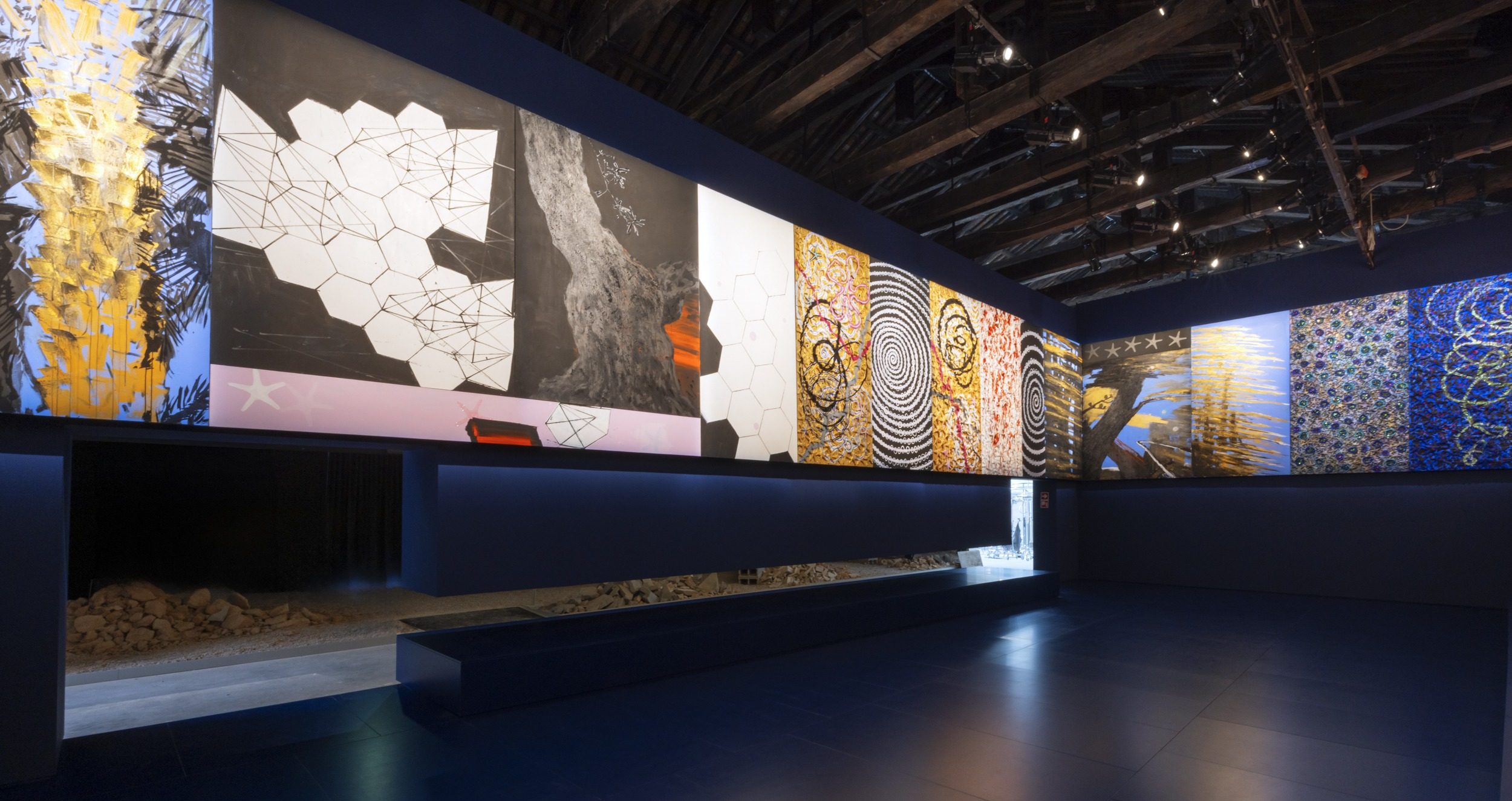
| | - Lebanon lands in Venice: The Lebanese Pavilion opened at La Biennale Arte 2026 on May 6 in Venice, featuring Lebanese-American artist Nabil Nahas's immersive installation "Don't Get Me Wrong"—26 acrylic panels each three meters high, spanning 45 linear meters at the Arsenale, on view through November 22.
- Beirut's voice, forty days on: Daraj marks the fortieth day since the passing of Ahmad Kaabour—the singer whose voice became inseparable from Beirut itself—with a tribute describing how his songs transformed the city's neighborhoods, sea, and memory into something the ear could love before the eye even looked.
- Milia M, forever: Lebanon Traveler honors the late designer Milia Maroun—who launched her ready-to-wear label Milia M in 2000, showed at Milan Fashion Week in 2008, and exhibited at Munich's Haus der Kunst—as a pioneer who proved Lebanese design could be global, accessible, and intellectually serious all at once.
- Villa, 30 years in the making: Aston Villa reached the Europa League final after a dominant semi-final performance, with Ollie Watkins and Emi Buendia—who scored a composure-defining penalty—leading the charge; manager Unai Emery will now contest his sixth Europa League final, having won four of his previous five.
|
|
Yalla, go make it a good Friday. |
| ✓C. Refuses to listen deliberately |
Someone who is able to listen, but decides to be intentionally deaf. |
Lebanon news for the diaspora — delivered every weekday morning. Free, sharp, ~5 minutes. |
|
|
|
|