|   | Bonjourein from your Sunday morning catch-up. It was a heavy week back home. Lebanon-Israel negotiations resumed in Washington as a fragile ceasefire continued fraying at the edges — strikes kept coming, displacement kept spreading, and the toll kept climbing. Health Minister Nassereddine put numbers to the pain: 2,882 dead and 8,768 wounded since March 2nd. Meanwhile, a Carnegie analysis warned that Israel's occupation has quietly shrunk Lebanon by hundreds of square kilometers, while invisible sectarian fault lines harden across the country. Here's everything that mattered this week. |
|
| | - Ceasefire in Name Only: Lebanon and Israel held a third round of direct talks in Washington on Thursday and Friday, with Lebanese diplomat Simon Karam leading Beirut's delegation. The so-called ceasefire — which Lebanon's Health Minister called "ineffective" — had by Tuesday produced 380 deaths and 1,122 injuries since the cease-fire began.
- Lebanon's Map Is Shrinking: A Carnegie Endowment analysis published Friday found Israel now occupies roughly 608 square kilometers of Lebanese territory — about 6% of the country — after establishing a so-called "yellow line" under the April 17 ceasefire terms. Dozens of villages have been razed into militarized buffer zones, and Israeli evacuation orders kept expanding into the Bekaa Valley throughout the week.
- What's Actually on the Table: Al Jazeera broke down the Lebanon-Israel negotiation dynamics this week: Lebanon entered talks asking for a ceasefire enforcement first, while Israel continued striking the country and sought Hezbollah disarmament. The country's top three leaders — President Aoun, PM Salam, and Speaker Berri — couldn't agree on whether talks should even be direct.
- A Doctor Who Stayed: A moving profile published Thursday followed surgeon Ibrahim Faraj, who has remained at the Lebanese-Italian Hospital in Tyre through every war since 1993. The WHO documented 2,586 deaths and 8,020 injuries in Lebanon between March 2 and April 30, with 16 hospitals damaged and 3 closed entirely.
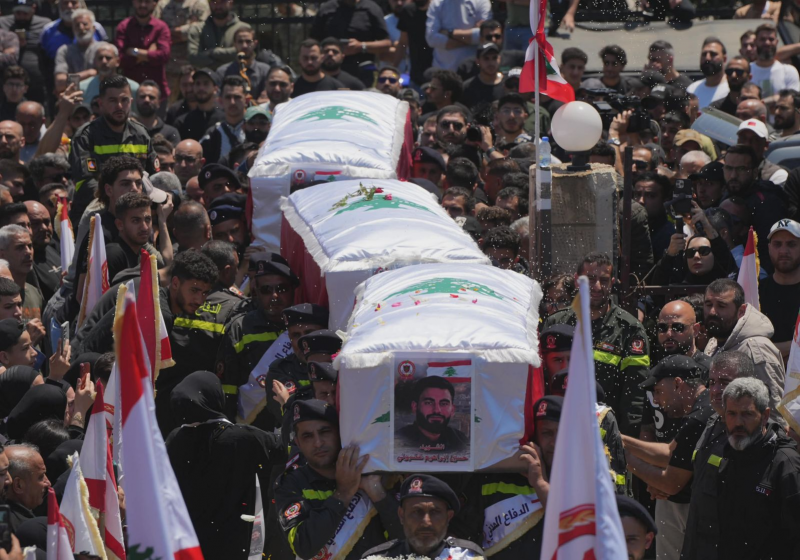
- Buried Twice, Grieved Twice: A devastating piece this week reported on temporary "wadi'a" burial sites near Sidon, where families inter their dead in wooden caskets until they can return home. Since March 2, at least 91 people have been buried this way in the Haret Saida cemetery alone, with the count still rising despite the April ceasefire.
- A Lost Generation in School: Experts told Al Jazeera this week that the war has displaced more than 500,000 school-aged children, with 339 schools sitting in active warzones and hundreds more converted into shelters. Lebanon's Gini inequality coefficient had already risen from 0.32 in 2011 to 0.61 in 2023 — and the education gap is widening fast.
- Brevet Exams, Cancelled: Education Minister Rima Karami announced Friday that official Brevet (middle school) exams were scrapped entirely this year, replaced by school-based finals starting June 15. For the 42,000 students sitting the national Baccalaureate, the ministry will offer three staggered exam sessions, with students allowed to sit the test near wherever they were displaced.
- Israeli Settlers Eye the South: A far-right Israeli settler movement called Uri Tzafon — "Awake, North Wind" — made international headlines this week for its stated goal of permanently settling southern Lebanon up to the Litani River. Co-founder Anna Sloutskin told AFP the group has grown to dozens of families since 2024, though the Israeli government has given no official political backing to the movement.
- Cash Aid for Southern Families: Social Affairs Minister Haneen Sayyed traveled to Marjeyoun on Friday and announced cash assistance for more than 6,000 families in the Hasbaya and Marjeyoun districts. The support is part of a broader government program that has already reached more than 140,000 displaced families outside official shelters.
- Lebanese Cancer Breakthrough: A Lebanese medical team led by Dr. Wassim Medlej achieved a notable result this week: an 11-year-old girl with advanced bone sarcoma — previously considered out of treatment options — showed measurable improvement after a combined cryoablation and immunotherapy protocol developed in collaboration with European specialists. The team has since applied the approach in several Arab countries.
|
|
That's your week, wrapped. Rest up — we'll be back in your inbox tomorrow morning. |
Lebanon news for the diaspora — delivered every weekday morning. Free, sharp, ~5 minutes. |
|
|
|
|