|   | Sabah el kheir. While you were sleeping, a Daraj investigation landed like a bomb on Lebanon's banking establishment — turns out Blom's owners quietly moved $100 million offshore before the collapse, and the only person facing criminal charges is a depositor whose house got shelled. We've also got a community reckoning inside the Shiite world and new details on just how deep Iran's Revolutionary Guards were embedded in the last war. |
|
| | A Daraj Investigation Reveals How Blom Bank's Owners Moved $100M Offshore Before the CollapseWhile Lebanese depositors watched their savings freeze, the families controlling Blom Bank quietly funneled over $100 million through a Luxembourg holding company in the decade before the 2019 crisis — and paid themselves a final $18 million dividend just months before the walls came down.
- Between 2010 and 2019, Blom transferred over $250 million in dividends to Panorab, a Luxembourg-based family vehicle owned primarily by the Azhari and Shaker families, which then redistributed at least $100 million to its shareholders.
- In mid-2019 — roughly four months before the financial crisis erupted — Panorab paid its largest-ever dividend of $18 million to shareholders, even as Blom's own share value had already lost around $91 million on paper.
- By September 2024, Panorab was forced to slash its capital from $50 million to approximately $12.6 million, an implicit acknowledgment that three-quarters of its capital had eroded — while pre-crisis cash distributions remained in the families' accounts.
- Meanwhile, journalist Mehdi Karim — a Blom depositor whose home in Tyre was destroyed by Israeli shelling — received an in absentia criminal conviction for "sabotage" at the bank after he publicly demanded his frozen savings back.
What to watch: Whether Lebanon's new government, amid ongoing banking reform talks, will respond to the investigation's findings or whether Blom's leadership continues to face no formal accountability. Lebanon's Shiite Community Debates Its Place in the State — Beyond Hezbollah's ShadowA quiet but significant debate is gathering momentum inside Lebanon's Shiite community: with Hezbollah's military posture diminished after the latest war, what kind of political and institutional identity should Shiites build going forward?
- Calls are growing among Shiite intellectuals and civil society figures to revive the Higher Islamic Shiite Council — founded in 1969 under Imam Musa al-Sadr — as a formal institutional bridge between the community and the Lebanese state, rather than relying solely on party-aligned structures.
- In early May, the Council's Vice President Sheikh Ali Al-Khatib drew attention when he publicly emphasized a "state project" at the heart of al-Sadr's original vision, prompting observers to ask whether it signals a strategic repositioning.
- Analysts identify three paths for the community: reviving the Council as a state-facing institution, fostering a generational shift in political identity, or defaulting to stagnation while regional leverage remains the dominant factor.
Zooming out: This internal debate is unfolding against Lebanon's broader push to redefine the post-war political order — and the outcome will shape whether Shiite representation is anchored to the state or to external axes. Iran's Revolutionary Guards Fought Alongside Hezbollah — in Operations Rooms and on the GroundNew accounts confirm that Iran's Revolutionary Guards played a direct command role in the latest Lebanon war, not just as advisors behind the scenes but as officers on active fronts — a reality that Lebanon's government has begun formally pushing back against.
- Prime Minister Nawaf Salam moved in March to expel Revolutionary Guards personnel operating inside Lebanon, reinstating visa requirements for Iranians and asking authorities to halt unauthorized military or security activity by Guards members.
- Four Iranian officers killed in an Israeli strike on Beirut's Raouche district on March 8 were initially described as "diplomats" by Tehran, then mourned in Iran as Revolutionary Guards officers; Lebanese passports issued under false names were found at the targeted site.
- Political analyst Ali Al-Amin said that after Hezbollah's top commanders were assassinated in 2024, Guards officers stepped in to fill the command vacuum — and that body-recovery operations in the south were conducted exclusively by Hezbollah, with the Red Cross kept away.
- Hezbollah-aligned analyst Kassem Kassir estimated roughly 1,000 Hezbollah fighters were killed in the latest war, with around 500 missing, and denied Hezbollah faced a fighter shortage.
The bigger picture: The extent of Iran's direct battlefield presence in Lebanon sharpens the stakes of ongoing US-Iran negotiations — any de-confliction arrangement will have to reckon with a military entanglement far deeper than either side has publicly acknowledged. |
|
as of 4:21 AM GMT · Source: Polymarket |
What natural phenomenon occurs at Nahr el Kalb? Scroll to the bottom for the answer — or play all 10 at sobhiye.news/games/trivia |
| | - Pilot zones, stalled engines: Washington-brokered talks on handing parcels of occupied southern Lebanon to the Lebanese Army stalled Wednesday, per the US Ambassador, before resuming — the fifth round of negotiations is now drilling into specific areas, timelines, and army-vetting requirements.
- Baabda watch: Mediators are quietly moving on the Baabda–Haret Hreik line to arrange a Hezbollah visit to the Presidential Palace, a meeting that nearly happened last month before the Washington declaration of intent derailed arrangements — with Iran now signaling it wants the relationship with President Aoun reset.
- Aoun draws the line: President Joseph Aoun told a Lebanese Writers Union delegation that the Lebanese people have "one homeland, one flag, and one identity" and that only the state can protect them — as he simultaneously confirmed Washington negotiations are ongoing and entirely separate from the US-Iran Switzerland talks.
- Teen drivers, adult roads: A parliamentary proposal would lower Lebanon's driving age from 18 to 16 — a country that recorded 443 road deaths and 2,365 accidents in 2024, with young men already the most overrepresented group in crash statistics.
- Smart Beirut, smarter kids: The Beirut Municipality, Makhzoumi Foundation, and Um El Nour Association launched "Smart Beirut Prevention" — billed as the Arab world's first digital drug-prevention platform, combining an AI guidance assistant, a digital academy for parents, and a community early-warning system.
|
|
| ─ | Parallel Rate | 89,550 LBP | 0.00% | | ─ | Official Rate | 89,500 LBP | 0.00% | | ▲ | Gold | $4,010.9 | +0.52% | | ▼ | Bitcoin | $60,771 | -2.89% | | ▼ | S&P 500 | 7,358.22 | -1.53% |
as of 4:10 AM GMT · Source: lbprate, BDL, Yahoo Finance, CoinGecko |
| | Venezuela Hit by Back-to-Back Major Earthquakes, Tens of Thousands Feared DeadTwo powerful earthquakes struck Venezuela within seconds of each other Wednesday night, levelling buildings in Caracas and prompting a state of emergency — with US Geological Survey estimates putting potential casualties anywhere between 10,000 and 100,000 people.
- A magnitude 7.2 quake struck near San Felipe, roughly 284km west of Caracas, followed almost immediately by a magnitude 7.5 quake near Yumare — witnesses described experiencing both within less than a minute of each other.
- The Altamira neighbourhood in Caracas was described by Interior Minister Diosdado Cabello as facing an "alarming situation," with several buildings reported collapsed; Simon Bolivar International Airport sustained severe damage and was shut down.
- Acting President Delcy Rodriguez declared a state of emergency late Wednesday but provided no figures on injuries or fatalities, while fire departments, police, and civil assistance teams were activated for search and rescue.
What to watch: The death toll remains unknown as rescue teams work through the night — Venezuela's location in a major strike-slip fault zone between the Caribbean and South American tectonic plates, combined with Caracas sitting in a deep sedimentary basin, amplified the destruction significantly. NHS Maternity Scandal: 520 Mothers and Babies Harmed at Nottingham Trust Over 13 YearsA landmark three-year review of the UK's biggest childbirth scandal has found that 444 women and 76 newborns suffered "potentially avoidable" harm at a single NHS trust between 2012 and 2025 — and that senior managers were repeatedly warned and did nothing.
- Investigator Donna Ockenden's 401-page report found a "bullying and toxic culture" at Nottingham University Hospitals NHS Trust, chronic understaffing, and a pattern of staff not listening to women raising concerns about their care.
- Nearly half of the 66 current and former NUH executives asked to participate in the review refused to engage, despite repeated requests — a refusal the affected families called "appalling."
- The UK health secretary announced Martha's Rule — giving patients the right to an independent clinical second opinion — will be extended to every maternity unit in England, and NHS staff who refuse future inquiry evidence could face up to two years in prison.
The bigger picture: Ockenden is already leading similar reviews of maternity services in Leeds and Sussex, suggesting Nottingham's failures may reflect systemic rather than isolated problems across the NHS. AI Reads a 2,000-Year-Old Scroll Burnt by Vesuvius — Without Unrolling ItResearchers have used artificial intelligence to virtually unwrap and read a carbonised papyrus scroll from ancient Herculaneum that was destroyed when Mount Vesuvius erupted in AD 79 — uncovering 20 columns of previously hidden text covering more than a metre of charred papyrus.
- The scroll, named PHerc 1667, dates to the second or late-third century BC, making it one of the oldest in the Herculaneum collection; analysis suggests it is a stoic treatise, possibly authored by Greek philosopher Chrysippus, third head of the stoic school.
- The text discusses the stoic concept of hormē, or impulse, and phronēsis, or "practical wisdom" — including the line: "We will not grasp it, if in some way we depart from ourselves and from our own nature."
- The achievement is part of the Vesuvius Challenge, launched in 2023, which has distributed hundreds of thousands of dollars in prizes to teams using machine-learning algorithms to read the ink on hidden scroll layers via high-resolution X-ray images.
Zooming out: The project has now shifted, researchers say, from perfecting the technique of reading burned scrolls to the scholarly work of interpreting what the newly recovered ancient texts actually mean. |
|
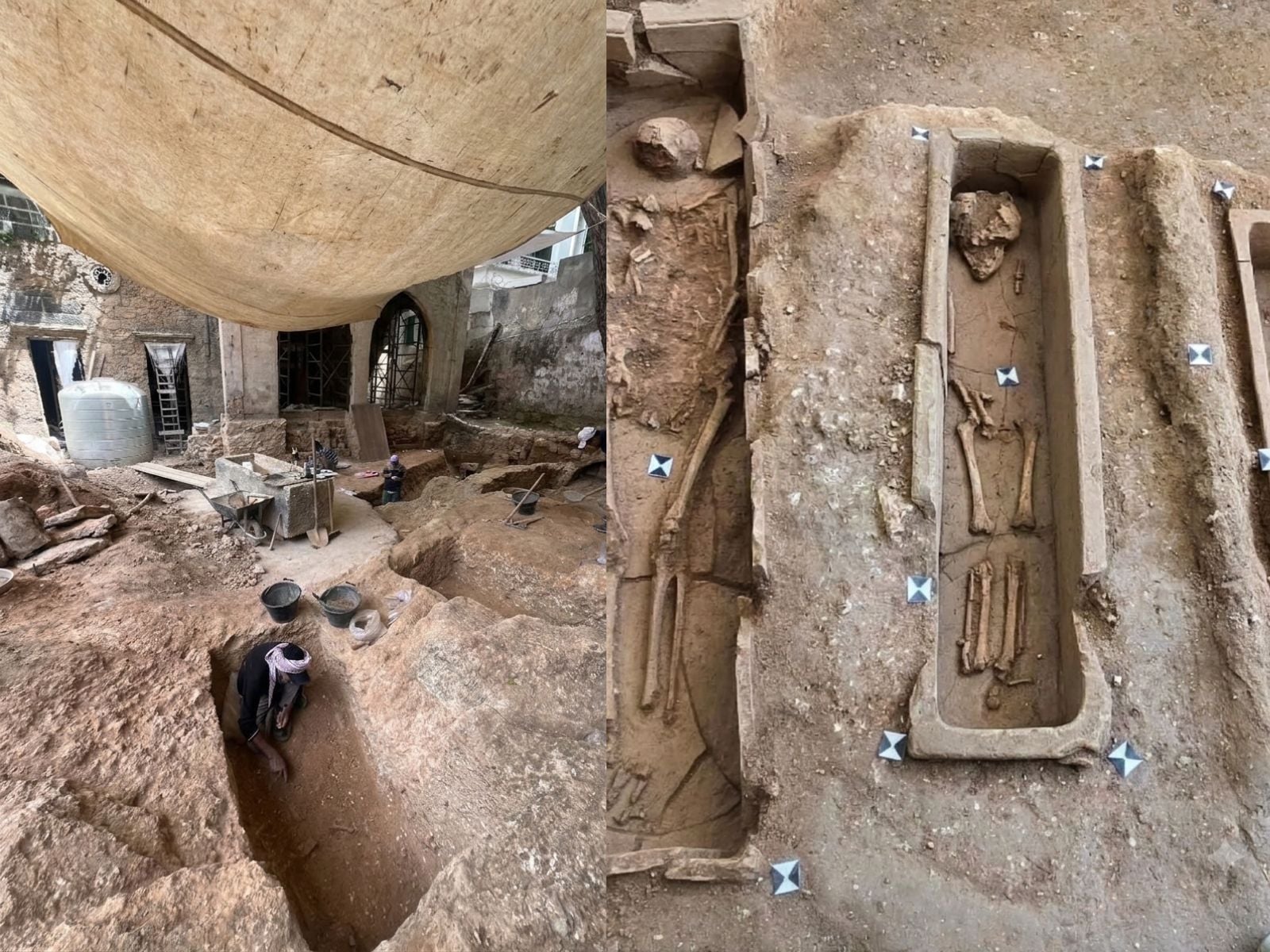
| | - Achrafieh's ancient secret: A Roman-era necropolis has been uncovered beneath the streets of Achrafieh, with the Directorate General of Antiquities now carrying out excavation and documentation work — another reminder that Beirut's soil holds more history than most cities put together.
- Brazil runs in the blood: Lebanese fans don't just cheer for Brazil out of style — it goes back over a century of emigration and family ties, including football legend Mário Zagallo, whose family traced roots to the city of Zahle and helped Brazil win four World Cup titles as player, coach, and assistant.
- The burger's cooler cousin: Arayes — spiced meat stuffed inside pita, grilled until golden and crackly — are officially having a moment, with Delish declaring the iconic Lebanese street food the dish you should be making at your backyard barbecue this summer instead of reaching for a burger.
- £64M and still not enough: Top tennis players are expanding their prize money protest at Wimbledon, limiting post-match media to 15 minutes throughout the first week — even after the All England Club announced its largest-ever prize fund increase to £64.2 million, still roughly £7 million short of what players had requested.
|
|
That's your Thursday — go make it a good one. |
The Dog River carved through mountains. |
Lebanon news, every weekday morning. Free, sharp, ~5 minutes. |
|
|
|
|