|   | Shou el akhbar — Lebanon woke up with a rare hat-trick of good news. Saudi Arabia's market is officially back open for Lebanese exports, the banks are posting actual profits again (complicated asterisks and all), and the Justice Minister flew to Paris to announce the end of the death penalty — to a standing ovation, no less. Three big moments worth your morning coffee. |
|
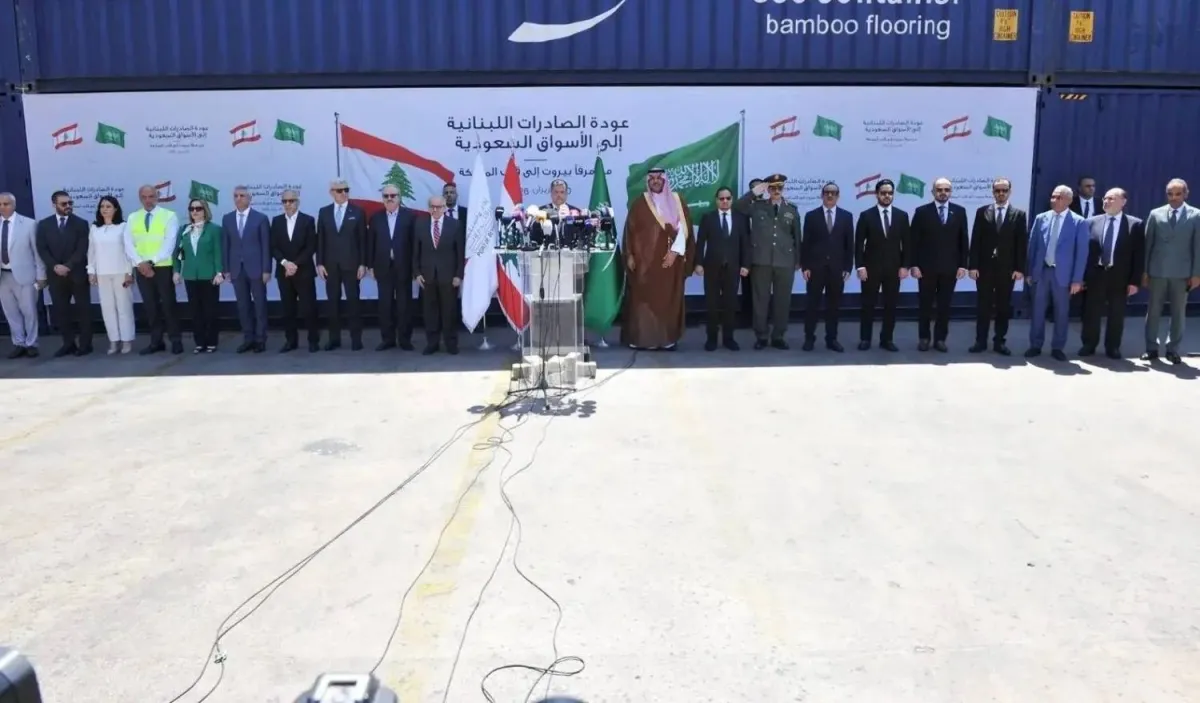
| | Saudi Arabia Opens Its Market to Lebanese Exports — For Real This TimeAfter years of a trade ban that cost Lebanon one of its most valuable export markets, Saudi Arabia has formally directed its private sector to start importing Lebanese goods again — a royal order, a first shipment, and new scanning machines at Beirut port to prove it.
- Saudi Arabia's General Authority of Foreign Trade circulated a royal order from Crown Prince Mohammed bin Salman to the Federation of Saudi Chambers, instructing companies to resume importing Lebanese products.
- The first shipment left Beirut port on June 20 bound for Jeddah Islamic Port, in the presence of Saudi Ambassador Fahd Al-Dosari — the ceremony was framed explicitly as a symbol of rebuilt trust.
- Saudi Arabia was Lebanon's top export market before the ban, accounting for roughly 12% of Lebanon's total exports and valued at approximately $378 million in 2014; the Kingdom alone represents about 85% of the Gulf market.
- Prime Minister Nawaf Salam said Lebanon would not be allowed to become a launchpad for harm against Arab neighbors, and the port's new scanning devices are designed to back that pledge with verifiable security controls.
Why it matters: Regaining access to a market that once dominated Lebanon's Gulf export market — at a moment when the country desperately needs hard-currency revenue — could meaningfully shift the economic outlook if the trade volumes actually recover. Lebanon's Banks Are Making Money Again — Sort OfLebanon's biggest banks are turning profits for the first time in years, but the numbers tell a more complicated story: the sector is still largely frozen in place, waiting for a restructuring that hasn't arrived.
- Bank Audi recorded profits of $19.39 million in Q1 2026, up from just $1.7 million in Q1 2025 — driven mainly by a 19% rise in commissions collected from customers, not a recovery in lending.
- Bank of Beirut and the Arab Countries swung from a loss of $59.75 million in Q1 2025 to a profit of $53.87 million in Q1 2026, while loans to customers rose 13% year-on-year to over $1.12 billion — a real, if narrow, return to lending.
- At the sector level, banks' placements with Banque du Liban still represent 75% of total balance sheet volume, while total loans have fallen to just 4.16% of the balance sheet — a year-on-year decrease of 7.36%.
Zooming out: The profit recovery signals that banks are stabilizing their income lines, but with three-quarters of assets parked at the central bank and restructuring still unresolved, the sector's ability to fuel a real economic rebound remains tightly constrained. Lebanon Announces It Will Abolish the Death Penalty — to a Standing Ovation in ParisLebanon's Justice Minister walked into an international congress in Paris and announced the country is formally moving to end capital punishment — drawing applause from the crowd and a pointed comment from Emmanuel Macron aimed at Israel.
- Justice Minister Adel Nassar announced at the 9th International Congress Against the Death Penalty that "Lebanon has begun the process of abolishing the death penalty after a moratorium of more than 20 years."
- The congress was organized by the French association Ensemble Contre la Peine de Mort (ECPM) and held at the Maison de la Radio et de la Musique in Paris on June 30.
- French President Emmanuel Macron publicly thanked Lebanon for the announcement, calling it a "courageous" decision while contrasting it with what he described as opposite moves elsewhere in the region.
What to watch: An announcement at an international congress is a political commitment, not yet a law — the question now is how quickly Lebanon's parliament translates the moratorium into formal abolition legislation. |
|
as of 4:18 AM GMT · Source: Polymarket |
| | - 235 to 189, Lebanon stays: The US House rejected a resolution demanding the withdrawal of American armed forces from hostilities in Lebanon — for the second time this month — with 22 Democrats crossing the aisle to vote it down alongside Republicans.
- Damascus makes its move: Syrian Foreign Minister Asaad al-Shaibani visited Beirut this week for his second trip since the fall of the Assad regime, meeting all three Lebanese presidencies in what analysts describe as the most serious attempt in decades to rebuild bilateral relations on equal sovereign footing.
- Airport road, rewritten: The "Thank you, Loyal Iran" banners that lined the airport road have been removed, replaced by "Lebanon First" signs — some of which were promptly burned by protesters, in a scene that captures exactly where Lebanon stands right now.
- Consumer cops on patrol: Lebanon's Ministry of Economy carried out 11,079 field inspection visits, issued 498 violation reports, and referred 671 cases to the judiciary since the start of the year through June 26, as market oversight campaigns continue under a ministerial circular.
- Lebanon's gymnastics standoff: A Beirut judge blocked elections called by the unrecognized Lebanese Olympic Committee, slapping a $10,000-per-hour fine on anyone who proceeded — ruling that international federations have no authority to call elections for national bodies, which remains a matter of Lebanese sovereignty.
|
|
| ─ | Parallel Rate | 89,550 LBP | 0.00% | | ─ | Official Rate | 89,500 LBP | 0.00% | | ▲ | Gold | $4,083.6 | +0.38% | | ▲ | Bitcoin | $60,868 | +3.10% | | ▲ | S&P 500 | 7,483.23 | +0.58% |
as of 4:07 AM GMT · Source: lbprate, BDL, Yahoo Finance, CoinGecko |
| | Syria's Missing Children: How the Assad Regime Erased Thousands of IdentitiesAn investigative report by the Tiny Hand organization reveals how children of detainees were systematically stripped of their names, registered under false identities, and scattered across a network of Assad-era care homes — and how thousands are still missing today.
- The Syrian Network for Human Rights database indicates at least 5,359 children remain under arrest or enforced disappearance from March 2011 to November 20, 2025, including 3,736 disappeared by the former Assad regime.
- Documents reviewed by investigators show children with known identities were registered as "foundlings" through a chain of security referrals, care homes, and police reports — with lineages formally altered in civil registries.
- Syria's current authorities launched a widespread arrest campaign in 2025, detaining former Ministers of Social Affairs and Labor and multiple care home directors as part of ongoing investigations into the file.
- A committee inside the Ministry of Social Affairs and Labor is verifying cases daily, but its coordinator told investigators the file is too large to be handled by one ministry alone.
The bigger picture: The scale of the file — children who grew up under different names, in different families, across a fractured country — means that even as Syria rebuilds institutions, the human cost of the Assad years will take decades to fully reckon with. Amnesty International: RSF Committed Ethnic Cleansing in Sudan's El-FashirAmnesty International has published a sweeping report accusing Sudan's Rapid Support Forces of crimes against humanity and ethnic cleansing during their campaign to seize the city of el-Fashir between 2024 and 2025.
- Amnesty interviewed 247 victims or witnesses between early 2024 and October 2025 in North Darfur, documenting systematic attacks on Zaghawa settlements around el-Fashir.
- The report alleged widespread deliberate violence against children, including killing, abductions, forced recruitment, and rape, with RSF fighters burning homes long after residents had fled — consistent, Amnesty said, with intent to render areas uninhabitable.
- During the RSF's final offensive on el-Fashir in October 2025, Amnesty said "hundreds were executed, and many others were tortured or detained" as they attempted to flee.
- A UN independent fact-finding mission in February had separately concluded that the 2025 assault on el-Fashir bore the "hallmarks of genocide."
What to watch: Amnesty stressed its investigation is ongoing and that its findings "may be relevant to the crime of genocide" — a legal threshold that, if pursued, would put pressure on the UN Security Council to act as the RSF now threatens el-Obeid in North Kordofan. Saudi Arabia's PIF Posts Record $17.36 Billion Profit as Assets Hit $1.21 TrillionSaudi Arabia's Public Investment Fund has published its first audited financials on the London Stock Exchange, revealing a year in which net profit more than doubled and total assets crossed the trillion-dollar mark — numbers that put it among the world's most consequential sovereign wealth funds.
- Net profit surged 152% to $17.36 billion in 2025, while operating profit climbed to $20.8 billion from $9.2 billion in 2024 — growth of more than 120%.
- Total assets rose 5% to $1.21 trillion, up from roughly 720 billion riyals in 2017, with the fund targeting 10 trillion riyals by 2030 under Saudi Vision 2030.
- The fund issued its first euro-denominated green bond worth 1.65 billion euros, with demand exceeding the offering by more than six times, signaling strong foreign investor appetite.
Zooming out: The PIF's trillion-dollar milestone — and its new 2026-2030 strategy shifting from sector-building to integrated economic ecosystems — positions Saudi Arabia as a central node in global capital flows at a moment when regional investment competition is intensifying. |
|
| | - Tripoli architect, Ankara honored: Lebanese architect and professor Khaled Tadmori from Tripoli received the Award of Excellence in Culture and Arts at an international ceremony in Ankara — recognized for decades of restoring Ottoman landmarks across Lebanon and the Arab world, from the Mansouri Great Mosque to Beirut's Sanayeh Garden.
- London's coolest bank heist: A former 1930s Lloyds Bank in Notting Hill has been transformed into Kinz, a Lebanese brasserie whose name means "treasure" in Arabic — complete with a converted vault wine room, Beirut-inspired ironwork, warak enab on the menu, and a lantern overhead that feels like a Beirut courtyard on a good night.
- Gulf visitors, Lebanon-bound: The UAE lifted its travel ban on Lebanon starting June 29, and tourism insiders say Emirati tourists — known for high average spending — could meaningfully boost hotel occupancy, restaurants, and the broader summer season that the sector relies on for a large part of its annual revenues.
- Palme d'Or, Oscar-eligible: Cristian Mungiu's Cannes Palme d'Or winner "Fjord," starring Sebastian Stan and Renate Reinsve, has qualified for the Oscars' international feature category without needing a country submission — one of the first films to benefit from the Academy's new festival-pathway rule — and opens in theaters on October 9.
|
|
Yalla, go make it a good Thursday. |
Farid was an oud virtuoso. |
Lebanon news, every weekday morning. Free, sharp, ~5 minutes. |
|
|
|
|