|   | Shou, is Israel really packing up from southern Lebanon — or just moving the furniture around? Sabah el kheir: this morning we're unpacking the "Grey Line" rebranding, a quiet American channel that technically doesn't exist, and a crisis inside the displacement crisis that didn't make the big headlines but should have. |
|
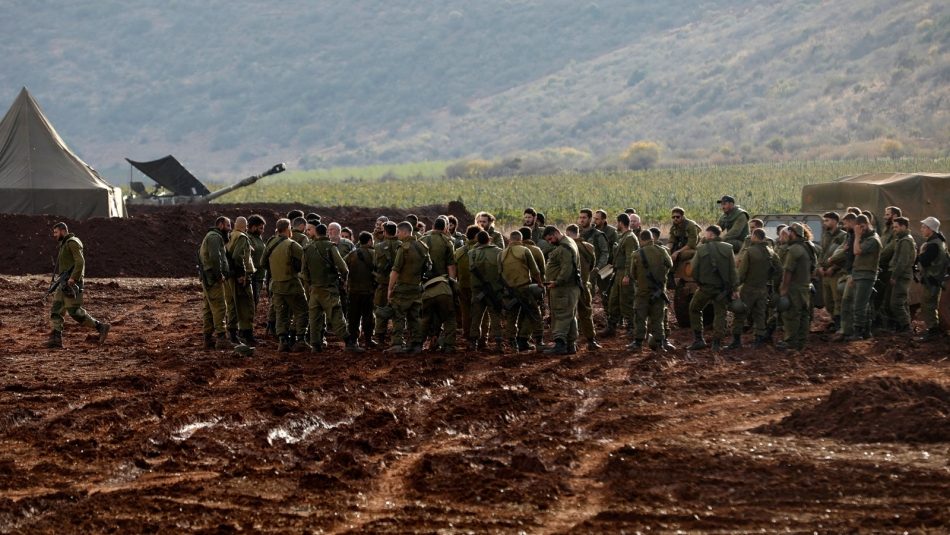
| | Israel's 'Grey Line' Plan: A Smaller Footprint, Same OccupationIsrael has reportedly been considering a plan to pull back from its current positions in southern Lebanon — not to the border, but to a new line just 2–4 kilometers deep inside Lebanese territory. It's a rebranding exercise as much as a military one: the color changes, the occupation stays.
- Israeli media outlet Kan 11 reported that Israel's military and political establishment are discussing withdrawing from the "Yellow Line" — which runs 8–10 km inside Lebanon — to a closer "Grey Line," where fixed posts would rely on surveillance, drones, and artillery rather than heavy ground forces.
- The plan has not yet been approved at the political level, and military analyst Brigadier General Hassan Jouni notes it contradicts Israel's own stated positions — Israel, he says, "does not withdraw for free."
- The leak may be deliberate: Jouni suggests it could relate to the concept of "experimental zones" in which the Lebanese army gradually takes over evacuated areas.
- Israel's claim of "operational control" over Ali al-Taher heights is contested — Jouni argues the phrase falls short of full control, and no detonation of the underground facility has occurred to confirm Israeli forces entered it.
What to watch: Whether the Lebanese army actually moves into any evacuated area will be the real test of whether this plan is a genuine drawdown or a permanent buffer zone dressed in new language. Washington's Quiet Channel: The Ali al-Taher Deal and the Shiite DuoIsrael's announcement of "operational control" over Ali al-Taher wasn't just a military update — according to informed sources, it was the first field test of a broader American-brokered understanding with Hezbollah and Amal, two movements Washington technically doesn't negotiate with directly.
- High-level sources told Al Liwaa that a preliminary understanding allowed Israel a symbolic field achievement at Ali al-Taher in exchange for halting further advances toward Iqlim al-Tuffah and other points.
- The US ambassador's visit to Netanyahu coincided with the Ali al-Taher announcement and a prisoner release, raising questions about coordinated sequencing.
- Hezbollah has maintained "constructive ambiguity" for months, issuing no statements on confrontations — a deliberate posture, sources say, rather than an admission of loss.
- The party argues Ali al-Taher sits north of the Litani and outside Resolution 1701 arrangements, and notes the Lebanese army itself declined to take over the hill, citing an inability to defend it without guarantees against Israeli return.
Zooming out: A US negotiating channel with Hezbollah — however indirect — would mark a significant shift in American policy, and both sides' denials are precisely what makes the sourcing worth watching closely. War Made It Worse: Displacement and Violence Against Women in LebanonAs Israeli airstrikes forced hundreds of thousands of Lebanese families to flee their homes this spring, a quieter crisis deepened inside shelters and shared apartments: gender-based violence surged, while survivors had nowhere safe to report it.
- ABAAD documented that psychological abuse rose from 47% of reported gender-based violence cases before the war to 65% during the March–June conflict period, making it the most common form of reported violence.
- Women and girls accounted for approximately 620,000 of the displaced population at the peak of escalation, with the UN estimating 325,500 displaced women of reproductive age, including around 13,500 who were pregnant.
- KAFA deployed outreach teams to 26 collective shelters, while ABAAD reached 10,144 people through prevention and response activities across all eight governorates.
- By early July, around 40% of those displaced had returned home, but more than 33,000 people remained in collective shelters — many in damaged or service-deprived areas where abuse continues.
The bigger picture: Lebanon's domestic violence law, passed in 2014 and amended in 2020, still lacks explicit criminalization of marital rape — and a broader proposed law on violence against women had not been adopted before the 2026 conflict began. |
|
as of 1:56 AM GMT · Source: Polymarket |
What continent did Phoenicians possibly reach? Scroll to the bottom for the answer — or play all 10 at sobhiye.news/games/trivia |
| | - Nearly 9,000 and counting: Israel's attacks on Lebanon since October 2023 have killed 8,920 people and injured 30,595 others, according to Lebanon's Health Ministry — with 4,358 deaths and 12,359 injuries recorded since March 2 alone, including 135 healthcare workers killed in 179 attacks on ambulance crews.
- Hospital reduced to rubble: Ghandour Hospital in Nabatieh al-Fawqa was completely destroyed by an Israeli airstrike this morning — the facility had already suspended operations two months ago due to the concentration of attacks on the area, and had previously served as both a medical center and displacement shelter.
- Zawtar's hollow return: Residents who went back to Zawtar al-Gharbiyah — designated a pilot zone — are finding no water, no electricity, and Israeli drones overhead the moment anyone moves; Israeli forces remain in directly adjacent Zawtar al-Sharqiyah, demolishing homes visible from across the square.
- War's quieter casualties: Lebanon's displaced children are regressing — losing speech, toilet training, and independence they'd already mastered, a child psychologist warns, with at least 100,000 children at risk of missing the September 15 school year as 340 schools were damaged or destroyed.
- Beirut Port, expanding: A cornerstone-laying ceremony for Beirut Port's expansion project is scheduled for next Thursday evening, with the project expected to take three to six months and targeting a capacity of more than 2 million standard containers annually.
|
|
| ─ | Parallel Rate | 89,600 LBP | 0.00% | | ─ | Official Rate | 89,500 LBP | 0.00% | | ▲ | Gold | $4,476.6 | +1.06% | | ▼ | Bitcoin | $79,943 | -0.05% | | ▲ | S&P 500 | 7,718.6 | +0.68% |
as of 1:38 AM GMT · Source: lbprate, BDL, Yahoo Finance, CoinGecko |
| Iran's Hormuz Gamble Isn't Paying Off the Way Tehran HopedSix months after a conflict that rattled global energy markets, Iran's strategy of disrupting the Strait of Hormuz — through which about a fifth of the world's oil and LNG passes — has not produced the economic shock on Western markets that Tehran anticipated. Washington's response: a naval blockade paired with what U.S. Treasury Secretary Scott Bessent called "the toughest sanctions in history."
- Three senior Iranian sources acknowledged that Washington's campaign is increasingly difficult to withstand, with restricted access to foreign currency, imports, and global financing networks.
- Energy markets have adjusted and alternative supplies continued to flow, limiting Iran's leverage.
- Iranian leaders fear surging prices and weaker trade could reignite domestic unrest, with shortages of fuel and wheat becoming an increasing concern.
- Former U.S. negotiator Dennis Ross suggested a possible off-ramp: Iran drops demands for a shipping toll through Hormuz while retaining the right to charge for navigational and security services — giving both sides a face-saving claim to victory.
What to watch: Whether mounting economic pain shifts Tehran's calculus before either side miscalculates into another direct confrontation is the question mediators are now quietly racing to answer. Germany's Far Right Just Made History in Saxony-AnhaltThe Alternative for Germany party has never governed a German state. That may be about to change. Sunday's exit poll in Saxony-Anhalt showed AfD taking 44.5% of the vote — far beyond the 20.8% it won in 2021 and above the 40% recent polls had predicted. If confirmed, it would be the first time a far-right party has held power in a German state since World War II.
- The CDU — which has governed Saxony-Anhalt for more than 20 years — collapsed to 18.5% in the exit poll, down from 37.1% in 2021.
- Voter turnout hit a record 76.5% among the state's 1.7 million eligible voters.
- All parties except the small BSW have ruled out a coalition with AfD — but the arithmetic of who clears the 5% threshold could still determine whether a "firewall" coalition is even possible.
- Nationally, AfD polls at 29%, and Chancellor Merz has become the most unpopular chancellor since the founding of the Federal Republic, with 85% of voters dissatisfied.
The bigger picture: A first AfD-led state government would test whether Germany's post-war consensus on keeping the far right from power can hold — and how far the party's platform on immigration, Russia, and culture shifts national politics. 9/11 at Twenty-Five: The Grief That Remade AmericaThis Thursday marks 25 years since the September 11 attacks killed nearly 3,000 people and set off a chain of wars, laws, and social fractures whose effects are still unspooling today. For the first time, a seventh bell will toll at Ground Zero — honoring the thousands who have since died from cancers and other illnesses caused by the attacks.
- Brown University's Costs of War project estimates that post-9/11 U.S. military operations in Iraq, Afghanistan, Syria, Yemen, and Pakistan killed nearly 1 million people between 2001 and 2023, including more than 400,000 civilians.
- More than 28,000 U.S. service members and veterans died by suicide in that same period — a figure now formally recognized at the annual commemoration.
- In the aftermath, between 2002 and 2003, 13,000 Muslim Americans faced deportation proceedings as F.B.I. dragnet sweeps swept across the country.
Zooming out: A quarter century on, the question The New Yorker poses is not just what 9/11 cost, but what the response to it built — and whether that construction has made America safer or more fractured. |
|
| | - Beirut heist hits Venice: Lebanese director Rami Kodeih's debut feature Furies — a raw, Beirut-set bank heist drama executive-produced by George Clooney — is wowing critics at the Venice Film Festival, with The Hollywood Reporter calling it "riveting from start to finish" and comparing it to a Lebanese anti-Ocean's Eleven.
- Lebanon's rally legend returns: The 48th International Rally of Lebanon roars back September 10–13 under the patronage of President Aoun, with Roger Feghali — holder of a record 18 titles — among the favorites to defend his crown at the oldest motorsport event in the Middle East, organized by a club founded in 1919.
- Ireland's greatest bows out: Katie Taylor, 40, retired from boxing in the most cinematic way possible — a unanimous victory in front of 83,000 fans at Dublin's Croke Park, sealing her legacy as a three-time, two-weight undisputed world champion and the woman who transformed women's boxing globally.
- Statues on the mountain: Lebanon Traveler maps seven monumental religious statues across Lebanon — from the rotating Christ statue in Ghosta that turns every six hours to face both mountains and coast, to the brand-new Christ the Redeemer in Al Qaa installed in 2026 — each one a quiet landmark of faith and resilience.
|
|
Start your Monday with something that made you proud to say where you're from — there was plenty of it today. |
Phoenicians may have sailed around Africa. |
Lebanon news, every weekday morning. Free, sharp, ~5 minutes. |
|
|
|
|