|   | Bonjourein. Lebanon's central bank just froze the accounts of the man who used to run it — and that's before we even get to transport unions threatening to shut the country down or Hezbollah drawing its clearest red lines yet on weapons. Three stories, one very Lebanese morning. |
|
| BDL Freezes Accounts of Riad Salameh, His Brother, and Nine OthersRiad Salameh ran Lebanon's central bank for three decades before his world collapsed: he was detained, indicted for embezzlement and illicit enrichment, and became the face of Lebanon's financial meltdown. Now the central bank he once led is coming after his money directly.
- BDL's Special Investigation Commission issued a confidential order dated September 18, 2026, directing all banks and financial institutions in Lebanon to freeze the accounts and assets of 11 individuals and 2 companies, including Salameh, his brother, and 9 others.
- Two Lebanese bankers confirmed that banks across the country received the BDL decision Tuesday morning, per L'Orient Today, which reviewed the document directly.
- The 13 names span several separate files, including U.S. sanctions cases connected to Hassan Moukalled's financial network.
What to watch: Whether the asset freeze translates into actual recovery of funds — or stalls in Lebanon's famously labyrinthine courts — is the real test of whether accountability has teeth this time. Transport Unions Warn of Strike After Government Ignores Its Own Cabinet DealLebanese commuters are already paying up to double what they paid months ago just to get to work — and now the unions say the government quietly pocketed fuel fees it was supposed to hand back to drivers and workers, and never did.
- A Lebanon 24 investigation found that "service" fares in Beirut and its suburbs have risen from roughly 200,000 LBP (about $2.20) to 400,000 LBP (about $4.50), and bus fares from 100,000 LBP (about $1.10) to 200,000 LBP (about $2.20), with taxi minimums starting at $10.
- Land Transport Unions chief Bassam Tleis accused the government of violating a February cabinet decision that required imposing fees on gasoline canisters to support employees, military personnel, retirees, and public drivers — and alleged the government collected the funds without disbursing them.
- The General Labor Union called an executive council meeting for Saturday, September 26, to recommend a warning strike, sit-ins, and coordinated regional actions with transport unions, public sector employee associations, and teachers' unions.
- With a gasoline canister approaching the $32 threshold and annual inflation running at 16.7% as of last August, multidimensional poverty now affects between 73% and 80% of Lebanese families, according to international organizations.
Why it matters: When the gap between what the government promises and what it delivers becomes this visible — in people's daily commutes — the political cost of inaction tends to compound faster than the fuel price does. Hezbollah's Raad Speaks: Weapons Stay Until Israel Fully WithdrawsTwo years after the death of Hassan Nasrallah, Hezbollah's parliamentary bloc chief Mohammad Raad gave a rare, wide-ranging interview — his clearest public statement yet on where the party stands on weapons, the Lebanese state, and what it would take to change its calculus.
- Raad told Al-Modon that Hezbollah's red lines have not changed since Nasrallah's death, and that handing over weapons or integrating the resistance into a national defense framework requires, as a prerequisite, a "sovereign authority" — plus full Israeli withdrawal, cessation of hostilities, and army deployment south of the Litani per Resolution 1701.
- He described the Lebanese government's path toward a framework agreement with Israel as "shame and submission," accusing it of squandering sovereignty and legitimizing the occupation.
- On the March 2 cabinet decision demanding Hezbollah disarm, Raad said the government wrongly treated the resistance's response to Israeli ceasefire violations as a declaration of war, while staying silent on Israel's ongoing breaches.
- Asked about American dialogue with Hezbollah, he offered just eight words: "I have nothing to say in this regard now."
Zooming out: Raad's framework — weapons tied to full Israeli withdrawal and a "sovereign" Lebanese state — sets the terms Hezbollah plans to carry into any coming negotiation, regional or domestic. |
|
as of 2:40 AM GMT · Source: Polymarket |
What does "Li baddo yitla3 3al 2erd, bi2allbo mawlana" mean? | Flattery gets you what you need |
| | | |
Scroll to the bottom for the answer — or play all 10 at sobhiye.news/games/trivia |
| | - Lebanon's constitutional clock problem: Germany's AfD won 43.8% of votes in Saxony-Anhalt but still can't form a government — because rules exist for when talks collapse. A Daraj analysis argues Lebanon's constitution has no equivalent deadline, leaving formation negotiations open-ended and obstruction costless.
- Cancer doesn't wait — Lebanon acts: The Ministry of Public Health and the Children's Cancer Center of Lebanon signed a memorandum of understanding to launch a national childhood cancer awareness initiative, committing to early diagnosis, improved referral pathways, and a pledge that no child will be denied treatment for financial reasons.
- Budget math that doesn't add up: Lebanon's draft Budget 2027 projects revenues and expenditures of 614.945 trillion LBP (about $6.87 billion) with a zero deficit — but 85.9% of revenues come from taxes, while civil society groups warn that defaulted public debt and arrears are kept entirely off the books.
- Sports corruption's domino effect: Beirut's Public Prosecution arrested former Lebanese Gymnastics Federation members Ghassan Majed and Mohamad Sharaf on charges of embezzlement and forgery linked to manipulated invoices for medal purchases from China, with further hearings and arrests expected in the coming days.
- AMIA trial, 32 years late: An Argentine federal judge ruled that 7 Iranian officials and 1 Lebanese Hezbollah figure will stand trial — in absentia — for the 1994 Buenos Aires bombing that killed 85 people, with asset seizures equivalent to 435 million euros ordered against each suspect.
|
|
| ─ | Parallel Rate | 89,550 LBP | 0.00% | | ─ | Official Rate | 89,500 LBP | 0.00% | | ▼ | Gold | $4,375.9 | -0.18% | | ▲ | Bitcoin | $86,321 | +0.89% | | ▲ | S&P 500 | 7,764.64 | +1.49% |
as of 2:16 AM GMT · Source: lbprate, BDL, Yahoo Finance, CoinGecko |
| | New York's $131 Million DoorDash Settlement Is the Largest for Delivery Workers in US HistoryNew York City just extracted the biggest delivery-worker settlement any American city has ever won. Mayor Zohran Mamdani's administration announced a deal with DoorDash that will send $115 million directly to workers who were paid less than the law required.
- The settlement, totaling more than $131 million, covers 260,000 delivery drivers and found DoorDash failed to meet minimum pay requirements between December 2023 and June 2026, per a nearly 70-page consent order reviewed by Al Jazeera.
- Workers who received no payment will get 200% of what they were owed — meaning a worker owed $1,000 receives $3,000; a worker paid late receives $2,000.
- DoorDash confirmed roughly $6.6 million in payments never reached drivers and more than $5.7 million were paid late.
- The remaining $16 million goes to civil penalties and costs.
The bigger picture: New York's minimum-pay rule for app-based delivery workers — established in 2023 — is now being tested as a national enforcement model, with Seattle already following a similar path. Germany's CDU Fails to Enter a State Parliament for the First Time in Its HistoryChancellor Friedrich Merz's Christian Democrats suffered an unprecedented collapse in two German state elections on September 20, failing to clear the 5% threshold in Mecklenburg-Western Pomerania — the first time the CDU has ever been shut out of a state parliament entirely.
- In the northeastern state, the AfD more than doubled its previous result to 38%; in Berlin, the AfD grew from 9% to 16%, while the socialist Left Party more than doubled its share to 26% and won a city-state election for the first time.
- Merz acknowledged that federal policy failures contributed to the defeats, warning that more than 40% of Sunday's votes went to forces he described as "destructive" and opposed to the parliamentary system.
- The SPD's lead candidate in Mecklenburg-Western Pomerania, Manuela Schwesig, held at roughly 36% and is expected to remain state premier, likely forming a coalition with the Greens and the Left.
What to watch: Merz's planned pension and welfare cuts are now openly contested by SPD coalition partners and eastern CDU premiers alike, putting the federal government's reform agenda under immediate strain. Turkey and the US Sign a $2 Million Deal to Study Small Nuclear ReactorsTurkey is quietly building a nuclear future that doesn't depend entirely on Russia. Ankara and Washington signed a grant agreement Tuesday in New York to fund a technical study on deploying small modular reactors — a technology the US is eager to sell and Turkey is eager to diversify into.
- The US Trade and Development Agency and Turkey's state-owned nuclear developer TUNAS signed the agreement, with the roughly $2 million grant funding a regulatory and financial feasibility study expected to last at least a year, according to Bloomberg HT.
- Turkey's first nuclear plant, the roughly $20 billion Akkuyu facility being built by Russia's Rosatom, has a combined capacity of 4,800 megawatts across four reactors, with first electricity now targeted for 2026 after repeated delays.
- Ankara aims to have 12 large conventional reactors and another 5,000 megawatts of small modular reactor capacity by 2050, enough for nuclear to supply roughly 10% to 15% of the country's electricity, Energy Minister Bayraktar said previously.
Zooming out: The deal reflects Ankara's long-running strategy of keeping energy doors open with both Washington and Moscow simultaneously. |
|
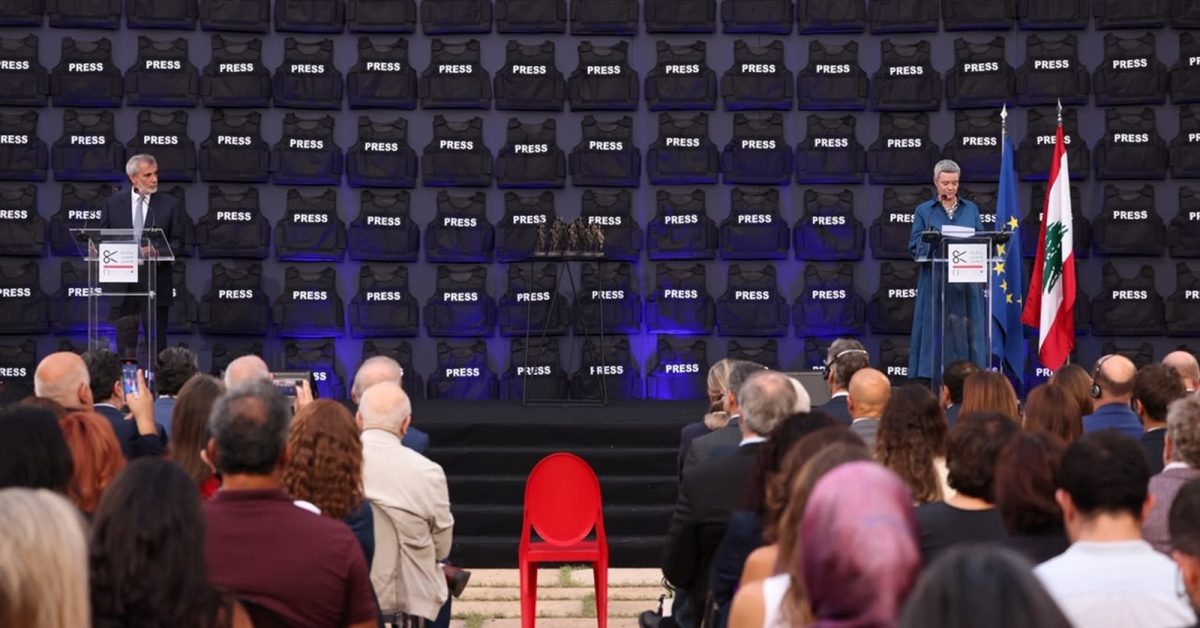
| | - Beirut's press freedom moment: The 21st edition of the Samir Kassir Award for Freedom of the Press was held in the gardens of Sursock Palace, drawing 300 journalists from 18 countries — with Lebanese filmmaker Anthony Barakat winning both the audiovisual category and the special Students' Award for his report on Roumieh Prison.
- Tom Cruise, meet royalty: Prince William and Princess Catherine attended the London world premiere of Digger — Tom Cruise's new satirical black comedy directed by Alejandro González Iñárritu — where Cruise told the crowd he believes human craftsmanship will always outlast AI, and caused the royals to burst out laughing mid-red-carpet.
- Six years old, world record: Chinese speedcuber Lian Yunzhi — nicknamed "Zhizhi" — broke the women's Rubik's Cube world record twice in one month, posting an average of 4.27 seconds and becoming the first female solver to average under 4.5 seconds, after mastering more than 1,300 solving algorithms.
- Beirut on the big screen: Shadows of Beirut, a film shot partly in the Lebanese capital and partly in Bulgaria, is drawing international attention for its lived-in portrait of the city — with The Guardian praising the Arabic-language scenes as the film's most compelling, capturing Beirut's chaotic, beloved energy in full.
|
|
Yalla, take something warm into your Wednesday evening — back in your inbox tomorrow morning. |
| ✓A. Flattery gets you what you need |
Very Lebanese, very ironic, strategic flattery, not humility. |
Lebanon news, every weekday morning. Free, sharp, ~5 minutes. |
|
|
|
|